

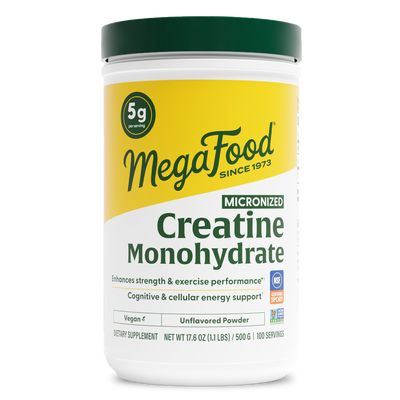
Creatine has earned a reputation as a “gym supplement,” but there’s so much more to it than that. Despite decades of research, myths about creatine’s safety, purpose, and side effects still circulate.
Let’s clear the air—and look at what science actually tells us about this well-studied nutritional ingredient.
Myth #1: “Creatine will damage your kidneys”
The concern: Because creatine is converted into creatinine (a common marker used in blood tests to infer kidney health), some worry it may be hard on the kidneys.
The truth: Research consistently shows that in healthy adults, creatine supplementation does not harm kidney function when used as directed. This myth persists partly because elevated plasma creatinine is often interpreted as a sign of kidney disease. However, when creatine is supplemented, an increase in plasma creatinine is expected—it’s simply a normal byproduct of creatine metabolism and not a true indicator of kidney disease [1][2][3].
The takeaway: For healthy adults, creatine is safe and well-tolerated. If you have kidney concerns or take medications that affect kidney function, it’s always best to check with your healthcare provider first.
Myth #2: “Creatine makes you gain fat”
The concern: Some people notice a few extra pounds after starting creatine and assume it means fat gain.
The truth: That early change on the scale mostly comes from extra water accumulating inside muscle cells, which supports cellular hydration, energy production, and performance—not from added fat tissue. Over time, creatine helps promote lean muscle mass (when combined with resistance training), which is a healthy, strength-supportive kind of gain [4][5].
The takeaway: Creatine supports muscle energy, size, and performance—not fat gain.
Myth #3: “Creatine causes bloating or puffiness”
The concern: Because creatine affects muscle hydration, some worry it causes bloating or a soft appearance.
The truth: Creatine supports intracellular hydration, meaning water moves primarily into the muscle cells—where it contributes to cellular energy metabolism, recovery, and muscle performance. This can increase muscle fullness, but it doesn’t cause subcutaneous water retention or gastrointestinal bloating. Any mild fullness typically stabilizes within a week or two [6]. If this appearance feels undesirable, stopping supplementation will quickly reverse the effect.
The takeaway: A bit of extra muscle fullness is normal and reflects creatine doing its job—supporting your body’s natural energy and recovery processes.
Myth #4: “Creatine is only for bodybuilders”
The concern: Many think creatine is only for professional athletes or those training at high intensity.
The truth: Creatine supports energy (ATP) regeneration in every cell of the body—especially in muscles and the brain. That means it can benefit a wide range of people, from those building strength at the gym to anyone wanting to support energy, cognition, or healthy aging. Since dietary creatine occurs naturally in meaningful amounts only in meat and seafood, research also shows stronger benefits for vegetarians and vegans, whose diets naturally contain less creatine [7][8].
The takeaway: Creatine isn’t just for athletes—it’s for anyone who wants to support physical and mental energy, strength, and recovery.
Myth #5: “You have to load and cycle creatine”
The concern: Many believe creatine requires complicated “loading” or “cycling” phases.
The truth: A short loading phase (around 20 g per day, split into four daily doses for 5–7 days) can help saturate muscles more quickly, but research shows that a consistent daily dose of about 3–5 g achieves the same effect within four weeks [9][10]. There’s also no need to cycle off creatine when taken at recommended doses.
The takeaway: Daily, consistent use works just as well—and is simpler to maintain long term.
Myth #6: “Creatine is unnatural”
The concern: Some assume creatine is an artificial compound found only in supplements.
The truth: Creatine is a natural compound made in the body from amino acids and found in foods like red meat, seafood, and dairy. Still, most people don’t get enough through diet alone to maximize their muscle stores—especially those who eat little or no meat [7].
The takeaway: Creatine isn’t foreign to your body—it’s something your body already uses to create energy. Supplementation simply helps maintain optimal levels to support both muscle and brain function.
The Bottom Line
Creatine monohydrate is one of the most researched and effective nutrients for supporting energy, performance, and recovery. When used responsibly and as directed, it:
- Does not harm healthy kidneys
- Helps replenish muscle energy (ATP) during activity
- Supports lean muscle mass and recovery with training
- Helps provide cognitive and muscular energy support
- Can be especially beneficial for vegetarians and vegans
- Does not require complicated loading or cycling
Whether you’re an athlete, an active adult, or simply someone focused on long-term strength and energy, creatine can be a valuable addition to a balanced wellness routine.
Learn More
Explore more science-backed nutrition education, such as The Essential Guide to Collagen: Its Role in Skin, Joints, and Overall Wellness
References
- Gualano, B., et al. “Effects of Creatine Supplementation on Renal Function – A Systematic Review and Meta-Analysis.” Journal of Renal Nutrition. 2019.
- Poortmans, J.R., & Francaux, M. “Long-term creatine supplementation does not significantly affect clinical markers of health in athletes.” Journal of the International Society of Sports Nutrition. 2013.
- Forbes SC, et al. “Is It Time for a Requiem for Creatine Supplementation-Induced Kidney Damage?” Nutrients. 2023.
- Chilibeck PD, et al. “Effects of Creatine Supplementation Combined with Resistance Training on Lean Mass and Muscle Strength.” Nutrients. 2023.
- Cimino P, et al. “The Effect of Creatine Supplementation on Lean Body Mass.” Nutrients. 2023.
- Kerksick CM, et al. “Common Questions and Misconceptions About Creatine Supplementation.” Journal of the International Society of Sports Nutrition. 2021.
- Harvard Health Publishing. “What is creatine? Potential benefits and risks of this popular supplement.” 2024.
- My Cleveland Clinic Health. “Creatine: What it does, benefits, supplements & safety.” 2024.
- Kreider RB, et al. “Safety and efficacy of creatine supplementation in exercise, sport, and medicine.” Journal of the International Society of Sports Nutrition. 2017.
- Sports Science Exchange. “The Safety and Efficacy of Creatine Monohydrate Supplementation: What We Have Learned from 25 Years of Research.” Gatorade Sports Science Institute. 2017.


Leave a comment
This site is protected by hCaptcha and the hCaptcha Privacy Policy and Terms of Service apply.