
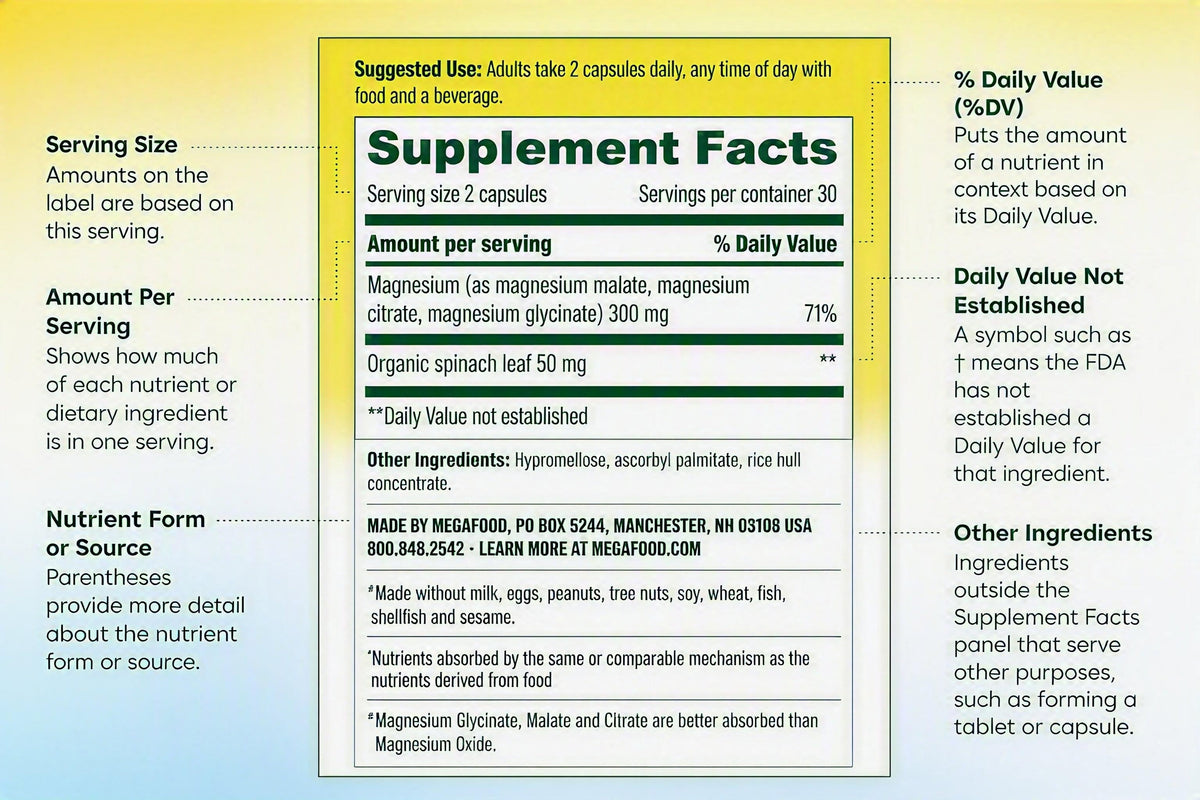
A simple guide to understanding serving sizes, Daily Values, ingredients, and more.
Have you ever picked up a supplement, turned the bottle around, and realized you weren’t quite sure what you were looking at?
You’re not alone. A Supplement Facts label can pack a lot of information into a pretty small space. But once you know what each section means, it becomes much easier to compare products and understand exactly what you’re taking.
Here’s how to read one from top to bottom.
Start With the Serving Size
Before looking at any of the numbers, check the serving size at the top of the Supplement Facts panel.
The serving size tells you how much of the product the nutrition information on the label applies to. Depending on the supplement, one serving might be one tablet, two capsules, three gummies, a scoop of powder, or another amount.
For example, if a supplement lists a serving size of two tablets and provides 100 mg of a nutrient per serving, you would need to take two tablets to get the full 100 mg listed on the label.
This is an easy detail to overlook, especially when comparing two supplements that have different serving sizes.
Look at the Amount Per Serving
Next, you’ll see how much of each listed nutrient or dietary ingredient is provided in one serving.
Depending on the ingredient, amounts may be listed in units such as:
- grams (g)
- milligrams (mg)
- micrograms (mcg)
- International Units (IU)
Pay attention to those units when comparing products. One milligram equals 1,000 micrograms, so two numbers that look similar at first glance may actually represent very different amounts.
You may also see certain vitamins listed in both micrograms and International Units or other units depending on the nutrient and labeling requirements.
What Does % Daily Value Mean?
The % Daily Value, or %DV, tells you how much a nutrient in one serving contributes to the Daily Value established for that nutrient.
As a general guide, the FDA considers:
- 5% DV or less to be low
- 10-19% DV to be a good source of a nutrient
- 20% DV or more to be an excellent source (or high in) a nutrient
But a higher percentage isn’t automatically better.
Nutrient needs vary, and supplements are formulated for different purposes. Some may provide around 100% of the Daily Value for a nutrient, while others provide considerably more or less.
The %DV is best thought of as a reference point that helps put the amount into context, rather than a score for how “good” a supplement is.
Why Do Some Ingredients Have an Asterisk Instead of a %DV?
You may notice an asterisk or other symbol next to some ingredients with a note that says something like:
“Daily Value not established.”
That doesn’t mean the ingredient has no value or that the amount isn’t known. It simply means the FDA has not established a Daily Value for that particular dietary ingredient.
This is common with ingredients such as certain herbs, plant compounds, and other dietary ingredients that aren’t vitamins or minerals with established Daily Values.
What's in Those Parentheses?
This is where supplement labels can start looking complicated.
You might see a nutrient followed by information in parentheses, such as the form or source of that nutrient.
For example, a label may list a mineral followed by the specific compound used to provide it.
Why does that matter? Nutrients can come in different forms, and the Supplement Facts panel gives you more information about what is actually used in the formula.
You don’t necessarily need to memorize every nutrient form. But if you’re looking for or avoiding a particular form, this is where you’ll often find that information.
What Are “Other Ingredients”?
Below the Supplement Facts panel, you’ll usually find a separate list labeled “Other Ingredients.”
These ingredients are part of the finished supplement but aren’t the dietary ingredients listed in the Supplement Facts panel.
Depending on the product, other ingredients may help form a tablet, make a capsule, maintain product consistency, or serve another function needed to manufacture the supplement.
Seeing an ingredient in this section doesn’t necessarily mean it’s a nutrient. It may simply be there to help turn the formula into the tablet, capsule, gummy, or other product you actually take.
Where Can I Find Allergen Information?
If you have a food allergy or sensitivity, don’t rely on the Supplement Facts panel alone.
Review the entire product label, including the ingredient list and any allergen statements, to determine whether a product contains an ingredient you need to avoid.
At MegaFood, all dietary ingredients present in a product in declarable quantities are disclosed on the product label. Always check the label of the specific product you’re considering, since ingredients can vary from one formula to another.
What Else Should I Look for on a Supplement Label?
The Supplement Facts panel is important, but it isn't the only useful information on the bottle.
Before taking a supplement, look for:
- Suggested use and serving instructions
- Storage instructions
- Allergen information
- Warnings or cautions
- Expiration or best-by information
- Certifications or other product-specific information
Together, these details can help you understand not just what's in your supplement, but how it's intended to be used and stored.
The Bottom Line
Reading a Supplement Facts label gets easier once you know where to look.
Start with the serving size, then look at the amount of each nutrient and its % Daily Value. Check the forms and sources listed alongside nutrients, review the Other Ingredients section, and don't forget the rest of the label for important information about allergens, storage, and use.
The goal isn't to find the supplement with the biggest numbers or the longest ingredient list. It's to understand what you're taking so you can make informed choices about the supplements that best fit your needs.


Leave a comment
This site is protected by hCaptcha and the hCaptcha Privacy Policy and Terms of Service apply.